
Instagram engagement rate: what the number misses
Two accounts can show the same engagement rate and leave you with completely different impressions once you open the posts. One starts useful conversations. The other has a giveaway doing most of the work. The percentage is a place to begin looking.
First, decide what “good” would look like
If you publish practical tutorials, a question from someone trying the technique may be useful feedback. If you are announcing a local event, a question about dates or access may matter more. If you are choosing a creator for a product demonstration, the clarity of the demonstration belongs in the decision alongside its reactions.
That does not make one type of comment universally more valuable. It makes the purpose of the post important. A percentage on its own cannot tell you whether the content did the job you had in mind.
Our recommendation is to avoid a universal pass mark. Compare similar work and ask what changed. Instagram’s own Best Practices resource includes personalized guidance on understanding engagement, which is more useful context than assuming every account should hit the same target.[1]
See what one exceptional post does to an average
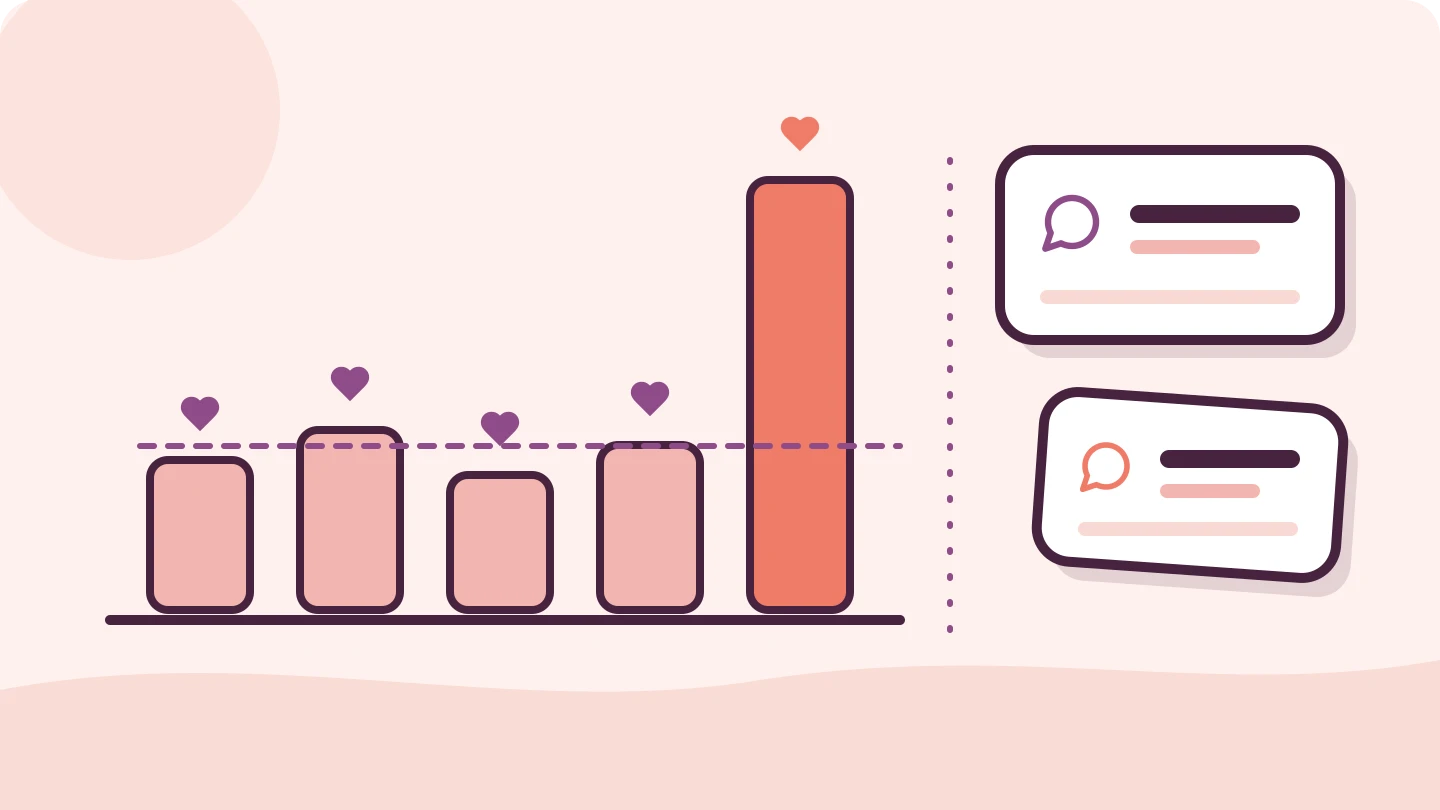
Consider five imaginary posts with visible reaction totals of 280, 300, 310, 320 and 2,790. Their average is 800. Four of the five posts are far below that number.
A made-up example, not an account benchmark
Average: 800 reactions. Middle value: 310. One post contributes almost 70% of the total.
The arithmetic is correct, but “this account usually gets 800 reactions” would be a poor description of this set. The middle value, 310, helps explain why the average feels surprising. These numbers are invented solely to show the effect of an outlier.
Open the exceptional post. Was it a giveaway, a collaboration, a major announcement or simply an unusually useful piece of work? You may not know the cause from the public view. You can still note that the recent result depends heavily on one post and ask whether the pattern appears again.
Read a few comments instead of grading their length
A comment count does not explain what the conversation is about. Ten people asking how to make a recipe are doing something different from ten people entering a prize draw. Criticism can also produce a busy comment section.
Read the original post and a selection of replies. Look for questions tied to the subject, whether the creator answers them, and whether the exchange would make sense to the people you want to reach.
Do not turn this into an authenticity detector. Short comments can be sincere, and detailed comments do not prove that an audience is genuine. Public comments give you conversation context, not a reliable inventory of who is behind every account.
Compare work that had a similar chance to perform
A new photo, a week-old Reel and an older competition post are not interchangeable observations. Before comparing results, write down the format, topic, publication date and any obvious promotion or collaboration. Allow for the fact that newer posts have had less time to collect reactions.
Meta explains that its systems combine multiple predictions and personalize what people see across Feed, Stories, Reels and other surfaces. Public likes alone cannot tell you which of those distribution effects shaped a post.[2]
- Compare similar topics and formats when you can.
- Keep unusually popular posts visible, but identify them.
- Check whether a short recent sample supports the conclusion.
- Leave hidden or unavailable counts as unknowns.
Meta gives people the option to hide public like counts. Filling an unavailable number with zero creates an answer you do not actually have.[3]
Ask for the evidence your decision needs
When you need to know whether viewers stayed with a video, ask the creator for relevant watch-time information from their own insights. Meta’s Reels guidance describes watch time as a way to understand viewing behavior beyond the view total.[4]
When you need to know whether a campaign drove enquiries or purchases, agree how those outcomes will be measured. A public engagement percentage cannot establish either result.
That question can lead to a useful conversation about the work. Asking whether a rate is “good” without discussing the posts usually cannot. Keep the percentage, but keep the posts beside it.
Sources & further reading
Sources checked 11 Nov 2026. Examples and review checklists are editorial guidance.
- Introducing Best Practices, an Education Hub for Creators on Instagram Meta · 1 October 2024
- How AI Influences What You See on Facebook and Instagram Meta · 29 June 2023
- New Features on Instagram Reels: Trends, Editing and Gifts Meta · 14 April 2023
Another perspective

How to read an Instagram profile beyond the follower count
A practical way to read the bio, recent posts and public numbers—without jumping to the wrong conclusion.
Before you book an Instagram creator, ask these five questions
Go from an appealing profile to a useful conversation about audience fit, creative work and what happens after posting.